Why reconstruct the ligaments?
The goal is to address giving-way episodes, repeated sprains and pain caused by persistent mechanical instability.
Chronic instability • ligaments • sport
When the ankle remains unstable despite appropriate rehabilitation, ligament repair or reconstruction can restore stability and confidence during walking and sport.
The choice of procedure depends on the diagnosis, alignment, tissue quality, activity level and the patient’s goals. Recovery protocols are individualised.
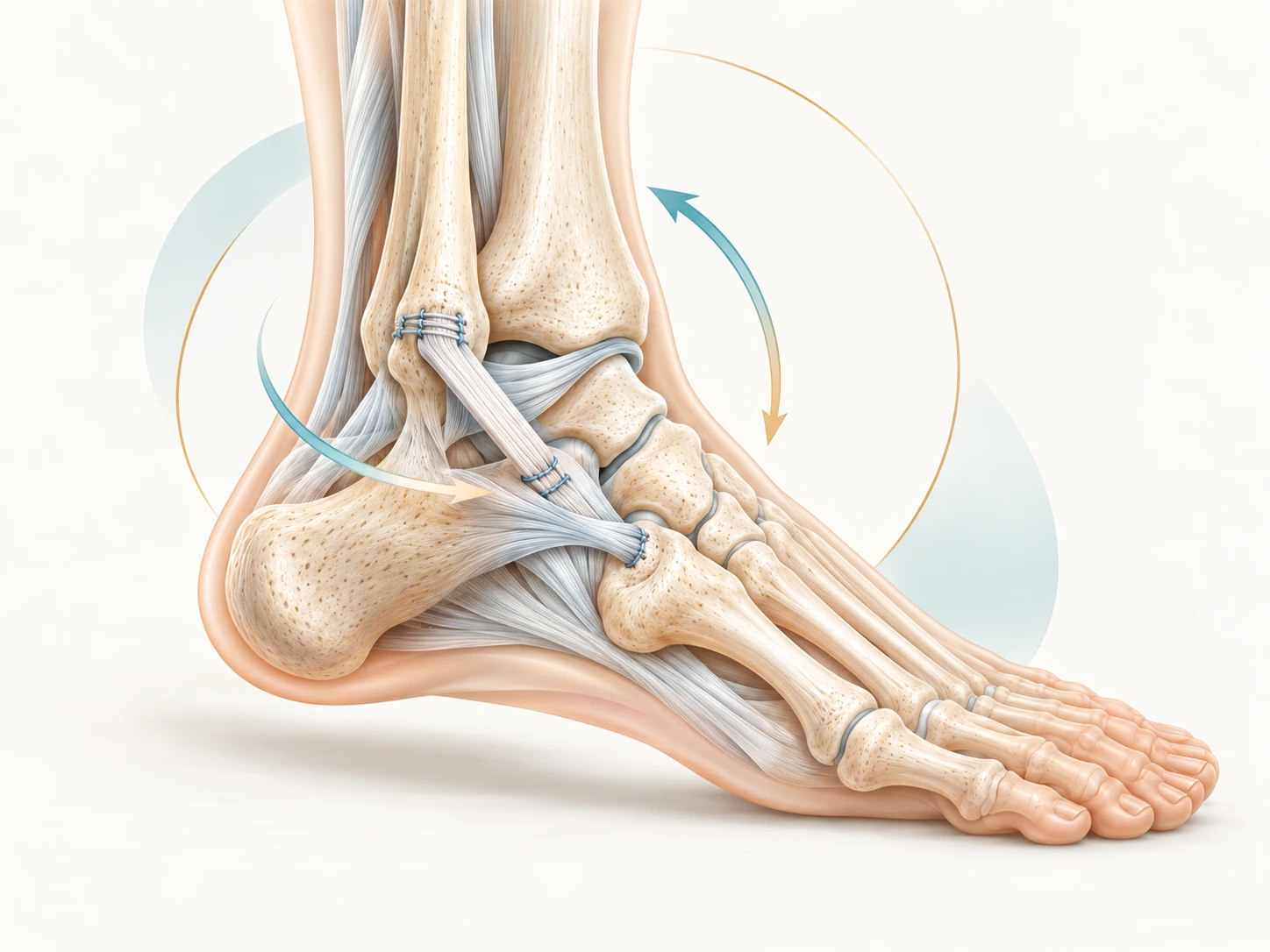
This illustration represents ligament reconstruction designed to restore ankle stability in chronic instability.
The goal is to address giving-way episodes, repeated sprains and pain caused by persistent mechanical instability.
Surgery is generally discussed when instability persists despite strengthening, proprioception, balance training and, when needed, bracing. Cartilage lesions, peroneal tendon problems and foot alignment are assessed at the same time.
When ligament quality is good, an anatomic repair such as a Broström procedure can be performed. If tissue quality is insufficient or in some revision cases, tendon graft reconstruction may be required. Arthroscopy can be added to treat intra-articular lesions.
Initial immobilisation, swelling control and protection of the repair.
Weight-bearing and motion are resumed according to the technique and associated procedures.
Return to pivoting and cutting sports is individualised according to strength, stability and neuromuscular control.
Risks include stiffness, irritation or reduced sensation around the incision, persistent or recurrent instability, infection and the general complications of surgery.
Source patient : AOFAS / FootCareMD. General information, to be adapted to each clinical situation.
Helping you move forward, step by step.
A consultation is an opportunity to discuss your situation, goals and the different treatment options.